
From Mango Street to global challenges
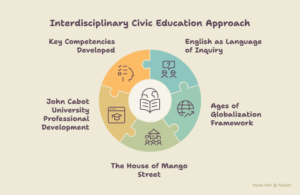
This Civic Education learning sequence uses English as the language of inquiry and dialogue to explore global citizenship through literature. It is built on two complementary pillars: the conceptual framework of Ages of Globalization, which our UNESCO Associated School uses to develop Civic Education pathways in English, and The House of Mango Street by Sandra Cisneros.
In connection with the study of Cisneros’ novel, John Cabot University in Rome offered Italian high school teachers a free-of-charge professional development course during the 2025–2026 school year. The present learning sequence is the outcome of that professional development experience and integrates the Ages of Globalization framework with the literary exploration of The House of Mango Street.
Through this interdisciplinary approach, students investigate issues of identity, inequality, inclusion, resilience, and sustainable development while strengthening their English language, critical thinking, systems thinking, and global citizenship competences.
Selection of vignettes from The House of Mango Street:
- My Name → identity
- The House on Mango Street → home
- A Rice Sandwich → education
- No Speak English → exclusion
- Cathy Queen of Cats → mobility and shifting identity
- Four Skinny Trees -> resilience and sustainable communities
- Bums in the Attic-> civic agency and aspiration
Subjects taught: English + Civic Education
Other relevant remarks for our educational context: Presence in the classroom of students with special needs, therefore, it is essential to include visual synthesis products that support comprehension and reduce linguistic and cognitive load.
Besides, the learning sequence promotes personal and orientation competencies
– reflection on personal identity, belonging, and future aspirations
– development of empathy and intercultural awareness through engagement with The House of Mango Street
– strengthening of autonomy, collaboration, and decision-making skills
Learning objectives (from Bloom’s Taxonomy):
By the end of the learning sequence, students will be able to:
Understanding
- recall key concepts related to globalization, identity, inequality, and sustainable development
- understand the main themes of The House of Mango Street (especially identity, belonging, gender, and social inequality)
- recognise key concepts from Ages of Globalization such as interdependence, global challenges, human development, and the Sustainable Development Goals (SDGs)
Applying
- relate the experiences of the characters in The House of Mango Street to real-world social and civic issues at local and global level
- use appropriate English vocabulary to describe social, cultural, and civic phenomena
Analyzing
- analyse how identity, inequality, gender roles, and belonging are represented in The House of Mango Street
- interpret and compare social conditions in the novel with contemporary local and global contexts
Evaluating
- critically evaluate how social, economic, and cultural structures shape individual identity and life opportunities in The House of Mango Street and in real life
- express and justify opinions on issues such as inequality, exclusion, education, and gender discrimination
Creating
- produce structured oral and written outputs in English (presentations, reflective texts, podcasts, digital stories) based on The House of Mango Street and global issues
- design simple systems-thinking representations linking causes and consequences of social inequalities
- propose realistic and responsible actions to improve local communities in a global citizenship perspective
Estimated learning sequence duration: Eight 60’ in-presence lessons + John Cabot University visit+ self-study
Lesson activities
LESSON 1 – Identity
AoG focus: Series intro
Mango street vignette: “My Name”
Essential question: How does our identity shape the way we see ourselves and the world?
Activities:
- Reading of “My Name”
- AoG Series intro
- Identity mapping activity
- Pair and class discussion
SDGs: SDG 10, SDG 16
Output: My identity map (personal + reflective version)
LESSON 2 – Home
AoG focus: Class 2 Chapter 4 – From Hunting and Gathering to Urban Life
Mango Street vignette: The House on Mango Street
Essential question: Can the place where we live influence our future?
Activities:
- Reading of The House on Mango Street
- Analyse SDG 11
- Compare Rome and Mango Street neighbourhoods
SDGs: SDG 1, SDG 11
Output: Housing reflection sheet
LESSON 3 – Education
AoG focus: UN@your doorstep: Access to quality education
PRE-Dialogue Pedagogical Resource on QUALITY EDUCATION – Documenti Google
POST-Dialogue Pedagogical Resource on QUALITY EDUCATION – Documenti Google
Mango Street vignette: A Rice Sandwich
Essential Question: How can schools become places of opportunity, belonging, and inclusion for every student?
Activities:
- Reading of A Rice Sandwich
- Analysis of school as a social institution (access, inclusion, dignity)
- AoG systems thinking: mapping barriers and opportunities in education
- Comparison between Esperanza’s experience and students’ school context in Rome
- SDGs: SDG 4, SDG 10
Output: Education systems map (“barriers and opportunities map”)
LESSON 4 – Social exclusion
AoG focus: Class 6 Chapter 3 – A Deeply Unequal and Divided World Part I
Mango Street vignette: No Speak English
Essential question: How do language and social systems shape inclusion and exclusion in multicultural societies?
Activities:
- Reading of No Speak English
- AoG data analysis on urban life (language, access, opportunity)
- Discussion: language as a tool of inclusion/exclusion
- Role-play: everyday situations involving language barriers (school, healthcare, public services)
- Comparison with students’ context in Rome (multilingualism, inclusion policies, school environment)
SDGs: SDG 10, SDG 11 , SDG 16
Output: Social inclusion systems map
LESSON 5 – Shifting identity
AoG focus: Class 6 Chapter 3 – A Deeply Unequal and Divided World, Part II
Mango Street vignette: Cathy Queen of Cats
Essential Question: How do changing communities shape belonging, identity, and social boundaries between “us” and “them”?
Activities
- Reading of Cathy Queen of Cats
- Discussion: changing neighbourhoods and social relationships
- Reflection: personal experience of belonging in changing contexts (school, city, peers)
SDGs: SDG 10, SDG 11, SDG 16
Output: Systems thinking task: “Community boundaries map”
LESSON 6 – Sustainable communities
AoG focus: Class 6 Chapter 3 – A Deeply Unequal and Divided World Part III
Mango Street vignette: Four Skinny Trees
Essential question: How can individuals and communities build resilience in challenging urban environments?
Activities:
- Reading of Four Skinny Trees
- Interpretation: trees as symbols of resilience in an urban context
- Recall of AoG ideas on cities as complex systems (urban challenges, human–environment interaction)
- Guided focus question: How do urban environments affect people’s ability to cope and grow?
SDGs: SDG 11, SDG 3, SDG 10
Output: Resilience system map: growing in the city
LESSON 7 – Civic agency
AoG focus: Class 28 Chapter 5 – The Leadership of Young People
Mango Street vignette: Bums in the Attic
Essential question: How can young people transform awareness of social problems into meaningful action?
Activities:
- Reading of Bums in the Attic
- Group work: choosing one civic issue (housing / education / gender / inequality)
- Systems thinking: from problem mapping → solution design
- Design of a Youth action plan connected to SDGs
- Preparation of ideas for academic dialogue with university students
SDGs: SDG 1, SDG 4, SDG 5, SDG 10, SDG 11
Output: “Youth action plan” (group project) → problem → causes → stakeholders → solution → expected impact
LESSON 8 – Academic dialogue and global citizenship communication
AoG focus: Review of the covered materials
Mango Street vignette: Students select one vignette from the sequence
(all previous vignettes are eligible)
Essential question: How can we communicate our ideas about social change in an academic and global context?
Activities
- Academic speaking training (use of evidence from text + AoG concepts + SDGs)
- Preparation of structured questions for university students
- Mock dialogue simulation (peer-to-peer academic exchange)
SDGs: Integrated review of all SDGs covered
Output: “Academic dialogue portfolio” including previous inputs
FINAL ACTIVITY – VISIT TO JOHN CABOT UNIVERSITY (Rome)
Activity title: “Global voices in dialogue: literature, identity and inequality”
Students meet university students studying The House of Mango Street
Output:
Students submit their portfolio
Rome, 4.7.2026 by M.R.Fasanelli
This learning sequence is featured in Resources for Teachers: Italy Reads 2026–2027.
0