
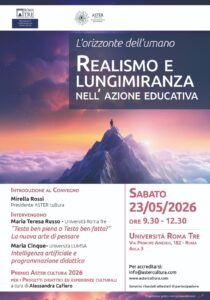
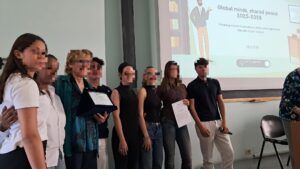
On the occasion of the presentation of the educational pathway Global Minds, Shared Peace, which brings together the three pillars of internationalisation at Liceo N. Machiavelli (eTwinning, Erasmus+, and UNESCO ASPnet), students presented our UNESCO activities at the conference “Realism and Foresight in Educational Action”, held on 23 May 2026 at Roma Tre University.
The conference featured two highly valuable academic contributions:
- “A Full Head or a Well-Formed Mind? A New Art of Thinking” by Prof. M. Teresa Russo (Roma Tre University)
- “Artificial Intelligence and Instructional Design” by Prof. Maria Cinque (LUMSA University)
Both contributions emphasised the idea that small, concrete steps can open pathways of hope grounded in commitment, dialogue, and collaboration. These reflections resonated strongly with the educational philosophy underpinning Global Minds, Shared Peace, a pathway inspired by the UNESCO vision that education is one of the most powerful tools for building a more peaceful and sustainable world.
As stated in the Preamble to the UNESCO Constitution:
“Since wars begin in the minds of men, it is in the minds of men that the defenses of peace must be constructed.”
From this perspective, peace is not merely the absence of conflict but an educational and cultural process nurtured through encounter, dialogue, cooperation, and mutual understanding. Exchanges among students and teachers, shared projects between schools and countries, the recognition of good practices, and international educational cooperation become essential tools for fostering global citizenship and building a culture of peace.
Within this framework, at Liceo N. Machiavelli the resources developed by the Ages of Globalization initiative have played a significant role not only in the teaching of Civic Education but also in the design of intercultural encounters involving students and teachers from different countries. Rather than limiting global citizenship education to classroom learning, the school has sought to transform international exchanges into meaningful learning opportunities connected to shared global challenges.
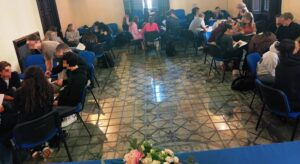
For example, during the visit of 20 students and 3 teachers from Frankfurt (Germany) in September–October 2025, the intercultural programme focused on environmental sustainability, drawing on the Ages of Globalization resource Environmental Sustainability. Students explored environmental challenges from both local and global perspectives and engaged in collaborative discussions on sustainable solutions.
Similarly, the visit of a UNESCO school from Helsinki in October 2025 centred on the theme of peace and cooperation, inspired by the Ages of Globalization chapter Finding Peace and Cooperation in a Deeply Divided World. Through dialogue and collaborative activities, students reflected on conflict resolution, peaceful coexistence, and the role of international cooperation in addressing contemporary global issues.
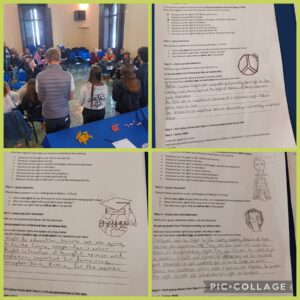
A further example was the group mobility involving German and Swedish students in February 2026. Through the activity Cards for Democracy, participants explored democratic participation, active citizenship, and the challenges facing young people today, supported by the Ages of Globalization chapter Class 1 Chapter 3 – Huge Challenges Facing the World Today, Especially Young People
In this way, Ages of Globalization has functioned not only as a curricular resource but also as a pedagogical bridge connecting classroom learning, international mobility, intercultural dialogue, and education for peace. By linking global themes to authentic encounters among young people from different countries, the project has helped transform internationalisation into a lived experience of global citizenship.
Within this broader framework, the conference also included the presentation and awarding of selected educational projects and cultural experiences developed by groups of teachers and students. We were honoured to receive First Prize for Global Minds, Shared Peace, in recognition of its educational value and its contribution to international collaboration, intercultural learning, and the promotion of global citizenship through concrete experiences of dialogue and cooperation.

0