
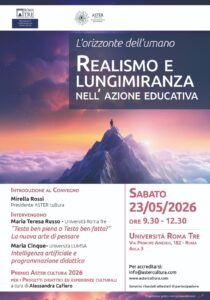
On the occasion of the presentation of the educational pathway Global Minds, Shared Peace, which brings together the three pillars of internationalisation at Liceo N. Machiavelli (eTwinning, Erasmus+, UNESCO), students presented the eTwinning project LEAP – Languages for Empowerment, Awareness and Peace at the conference “Realism and Foresight in Educational Action”, held on Saturday 23 May 2026 at Roma Tre University.
The conference featured two highly valuable academic contributions:
- “A Full Head or a Well-Formed Mind? A New Art of Thinking” by Prof. M. Teresa Russo (Roma Tre University)
- “Artificial Intelligence and Instructional Design” by Prof. Maria Cinque (LUMSA University)
Both contributions emphasised the idea that small, concrete steps can open pathways of hope grounded in commitment, dialogue, and collaboration. Within this framework, the conference also included the presentation and awarding of selected educational projects and cultural experiences developed by groups of teachers and students. In this context, our project was awarded first prize, in recognition of its educational value and its contribution to international collaboration and intercultural learning.
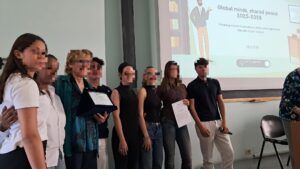
LEAP Project Overview (Student Presentation – Luca)
“LEAP (Languages for Empowerment, Awareness, and Peace) is an eTwinning project developed during the school year. eTwinning is a European digital platform that enables schools from different countries to collaborate through online activities, fostering cooperation among students and teachers across Europe.
From September to May, we worked continuously with our partner class from the ASGSG, Marl, in northern Germany, engaging in a wide range of collaborative activities such as forum discussions, language exchange tasks (Italian and German), shared storytelling, collaborative ebook creation, digital games, and celebrations of key international events including the European Day of Languages, International Education Day, Safer Internet Day, and Europe Day.
Throughout the year, we worked mainly in international groups and regularly discussed topics such as sustainability, human rights, and communication, using English as our working language.
The project is based on the idea that learning multiple languages is not only about communication, but also about understanding different perspectives, cooperating across cultures, and addressing global challenges together.”
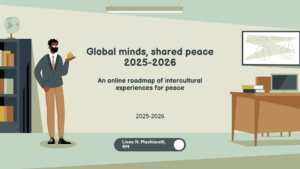
Video Conferences (Student Presentation – Benedetta)
“A central element of our project were four video conferences with our German partner school, which allowed us to synchronise and reflect on key stages of our collaboration.
13 January 2026 – Democracy and Journalism
We led an interactive activity in English (+chunks of Italian) focused on professions that support democracy, with particular attention to journalism. We introduced key vocabulary, supported pronunciation practice, and taught simple sentences related to information, truth, and rights. The German students did the same in their language, creating a reciprocal learning experience. The session included a reflective discussion on the role of journalism in democratic societies.
27 January 2026 – Language, Education and Metaphors
We engaged in three main phases: reciprocal vocabulary exchange (German, Italian, English) on school and education, a shared reflection on the “ideal school” for International Education Day, and a final creative task using metaphors to describe a “good teacher” in Italian, English, and German. This showed how language expresses not only meaning, but also values and worldviews.
10 March 2026 – International Women’s Day
We organised a video call focused on women’s activism and democratic participation. After an initial reflection, Italian and German students presented female activists such as Malala Yousafzai and Greta Thunberg using a five-sentence framework (who they are, what they believe in, what they fight for, the challenges they faced, and their achievements). We then reflected on how young people can continue their legacy in everyday life, concluding with a shared message that small voices can create big change.”
19 May 2026 – Language as a Tool for Conflict Resolution
In this session, we took part in a debate-based activity on democratic decision-making and conflict resolution. We discussed real-life situations such as bullying, class representation elections, environmental responsibility, refugee issues, youth centres closure, and online violence. We exchanged perspectives and worked together to identify the most responsible and democratic responses. The activity helped us understand how dialogue and active listening are essential in democratic life.
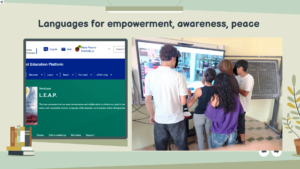
Reflection and Competences (Wrapping Up) (Student Presentation_Sosna)
Recently, our teachers introduced us to the global citizenship competence framework we have been working on throughout the year through international exchanges, both in presence and online. Key areas include global awareness, empathy and respect for diversity, active engagement, responsibility, and action.
Looking back, we realised how meaningful this experience has been. We also understood that mutual understanding is not always easy, even after months of collaboration. For example, while working on our joint eBook with the German partners, communication sometimes flows easily, while at other times misunderstandings arise. However, our group reminded me that we have always agreed to use respectful and constructive language in our collaboration.
We have learned that real understanding requires willingness from both sides. The risk of a “we versus them” mindset is always present, but the title of our project, Languages for Empowerment, Awareness and Peace, constantly helps us stay on the right path.
0