
Skills and competences acquired during Long-Term Erasmus+ Mobilities in France
As part of the Erasmus+ long-term mobility programme, two students from our school, A.D.M. and L.A., spent an extended period in France (from November 14 to December 14, 2025), at the Lycée Général et Technologique Camille Jullian in Bordeaux, experiencing daily school life, family life, and the cultural environment of the host country. Throughout the mobility, the students progressively developed a wide range of linguistic, personal, social, and intercultural competences, as reflected in their weekly self-assessment.
Understanding different educational systems
One of the first learning outcomes reported by the students was the awareness that school systems can differ significantly from one European country to another. Attending lessons in a French school helped them understand different teaching methods, classroom dynamics, assessment practices, and student–teacher relationships, fostering a more open and comparative perspective on education in Europe.
Week 2 (17/11/2025 – 23/11/2025): Autonomy and time Management
During the second week, students adopted sustainable mobility habits, using bicycles as their main means of transport between home and school, as is common among local students. This allowed them to explore the city independently and become familiar with its structure and main landmarks.
They also learned to manage their time effectively, balancing school commitments with leisure activities. Living in a host family with pets helped them develop a sense of responsibility and adaptability by taking care of animals and respecting family routines.
Week 3 (24/11/2025 – 30/11/2025): Linguistic and cultural Adaptation
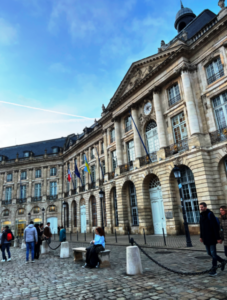
In the third week, students met other Italian Erasmus+ participants and fully immersed themselves in local culture by tasting typical dishes, shopping independently, and visiting iconic cultural sites, such as Bordeaux’s famous wine city, an outstanding example of contemporary architecture and cultural heritage.
Academically, they reported significant progress in studying in French, especially in listening comprehension, thanks to active participation in lessons. At the same time, they learned to adapt to the habits and expectations of the host family, strengthening their intercultural competence.
Week 4 (01/12/2025 – 07/12/2025): Social skills and everyday language
During the fourth week, one student stayed with the family of their Erasmus+ partner who had previously been hosted in Italy. Experiencing life in a larger family, including grandparents and siblings, enhanced their understanding of family dynamics in a different cultural context.
Students also learned to use public transport autonomously, move confidently around the city, and engage in family activities such as playing traditional card and board games. These informal moments were particularly valuable for acquiring everyday expressions and colloquial language.
Week 5: Communication and self-Confidence
In the final week, students presented a research project in French in front of their classmates and took part in extracurricular cultural activities, such as attending a theatre performance. These experiences helped them overcome the fear of speaking in public, increase self-confidence, and consolidate their communication skills in a foreign language.
Conclusion
Overall, the long-term mobility experience proved to be a powerful learning opportunity, fostering autonomy, responsibility, linguistic competence, intercultural awareness, and personal growth. Such experiences represent a strong example of the educational and orientative value of the Erasmus+ programme, empowering students to face new challenges and to grow as active, confident European citizens.
0